

10 February 2020. Addis Ababa, Ethiopia -The African Union launched at the 33rd Ordinary Session of the Assembly of Heads of State and Government of the African Union the second Biennial Review Report on the implementation of the June 2014 Malabo Declaration on Accelerated Agricultural Growth and Transformation for Shared Prosperity and Improved Livelihoods. H.E Abiy Ahmed Ali, Ethiopian Prime Minister and AU Leader of the Comprehensive Africa Agriculture Development Programme (CAADP), presented the Biennial Review Report to the AU Assembly of Heads of State and Government.


Under the process of the critical analysis and review, the BR Task Force highlighted the importance of two specific issues namely food insecurity and food safety issues that were not in the first BR exercise. These new indicators include:
- the Prevalence of moderate and severe food insecurity in the population based on the Food Insecurity Experience Scale (FIES)
- Food Safety Systems Index (FSSI) which measures a country’s performance in establishing food safety systems that meet international best practices and the Codex Alimentarius international food safety standards;
- Food Safety Health Index (FSHI) which measures a country’s performance in reducing cases of foodborne illnesses due to exposure to contaminated food, cases of foodborne deaths, and cases of liver cancer caused by dietary exposure to aflatoxins; and
- Food Safety Trade Index which measures the percentage reduction in rejected export shipments of food commodities due to food safety violations, disaggregated by the type of violation.


7 commitments translated into seven thematic areas of performance:
- Re-committing to the principles and values of the CAADP process;
- Enhancing investment finance in agriculture;
- Ending Hunger in Africa by 2025;
- Reducing poverty at least by half, by 2025, through inclusive agricultural growth and transformation;
- Boosting intra-African trade in agricultural commodities and services;
- Enhancing resilience of livelihoods and production systems to climate variability and other related risks; and
- Strengthening mutual accountability to actions and results.
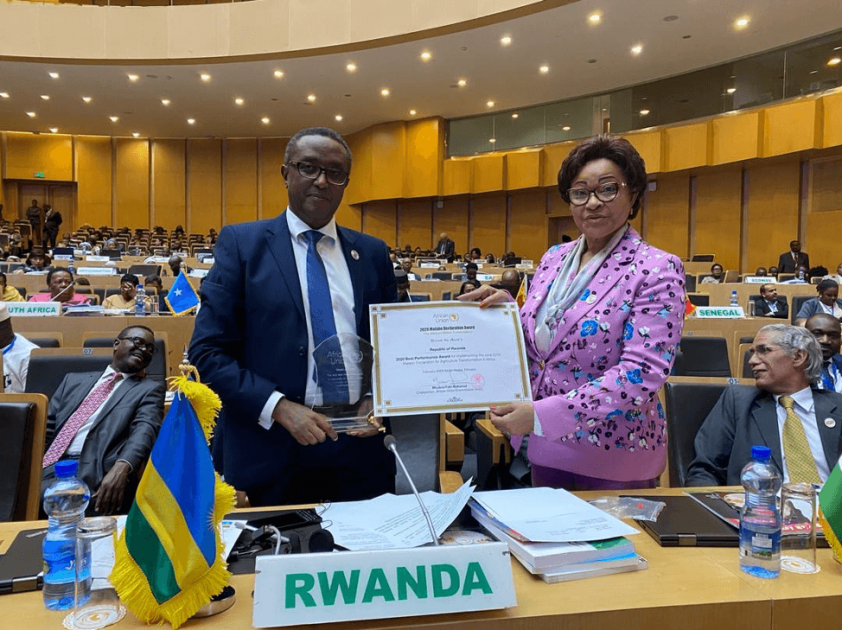 |
| Rwanda is once again, as was the case in 2017, the 2019 best performing country in implementing the seven (7) commitments of the June 2014 Malabo Declaration |
Analysis
“The Biennal Review Report is a performance assessment tool as well an advocacy tool to guide planning and decision making for Africa’s Agricultural Transformation.” H.E Josefa Sacko AUC Commissioner for Rural Economy and Agriculture
The benchmark for the 2019 cycle 6.66, is much higher than that of the 2017 cycle which was 3.94. The four Member States, which obtained or surpassed the benchmark of 6.66 to be on-track toward achieving the commitments of the Malabo Declaration by 2025 are: Rwanda (7.24), Morocco (6.96), Mali (6.82) and Ghana (6.67).
The document captures the continent’s agricultural progress based on a pan-African data collection exercise led by the African Union Commission’s Department of Rural Economy and Agriculture (DREA), AUDA-NEPAD and Regional Economic Communities in collaboration with technical and development partners. Member States were assessed on the seven commitments in the Malabo Declaration, across 47 indicators.
Further analysis of the reports (34 pages) shows that:
- The continent remains off-track in achieving the overall Malabo Declaration commitments, obtaining an overall score of 4.03 compared to the benchmark of 6.66 to be on-track.
- The continent lost its traction in Recommitment to the CAADP Process, Halving Poverty through Agriculture, and Mutual Accountability for Action and Results.
- Regarding Commitment 5 on Boosting Intra-African Trade in Agriculture Commodities, 29 countries are on track even though the continent as a whole is not on track.
- Only four countries Burkina Faso, Burundi, Mali and Mauritania met the target of spending at least 10 percent of the total national expenditure on agriculture.

The report tracks progress in commitments made by AU Heads of State and Government through CAADP and the Malabo Declaration to increase prosperity and improved livelihoods for transforming agriculture. The indicators chosen to track the performance categories were defined on the basis of the strategic objectives derived from the Malabo Declaration.
Source: PAEPARD FEED