

Mechanization of African Agriculture – Does it Create or Destroy Jobs? Launch of the german version of the MaMo Mechanized Report.
 |
| #Mechanization can create jobs if done right such as investing in skills development and trainings together with mechanization, said ZEF director #Joachimvonbraum now at the @MamoPanel in Berlin. @BMZ_Bund #InnovationDialogue @ZEFbonn @HelloTractor @Welthungerhilfe |
hunger.
A study by the “Malabo Montpellier Panel” describes the state of mechanization of agriculture in Africa. The panel provides recommendations for institutional reforms, innovative sector policies and cooperation with the private sector.
The study testifies to considerable increases in productivity by agricultural machinery and shows: Mechanization can certainly lead to more employment.
How and under what conditions does this work in smallholder African agriculture?
What possibilities does an inter-company use offer?
The panel discussed this with:
- Gunther Beger, Head of Department in the BMZ
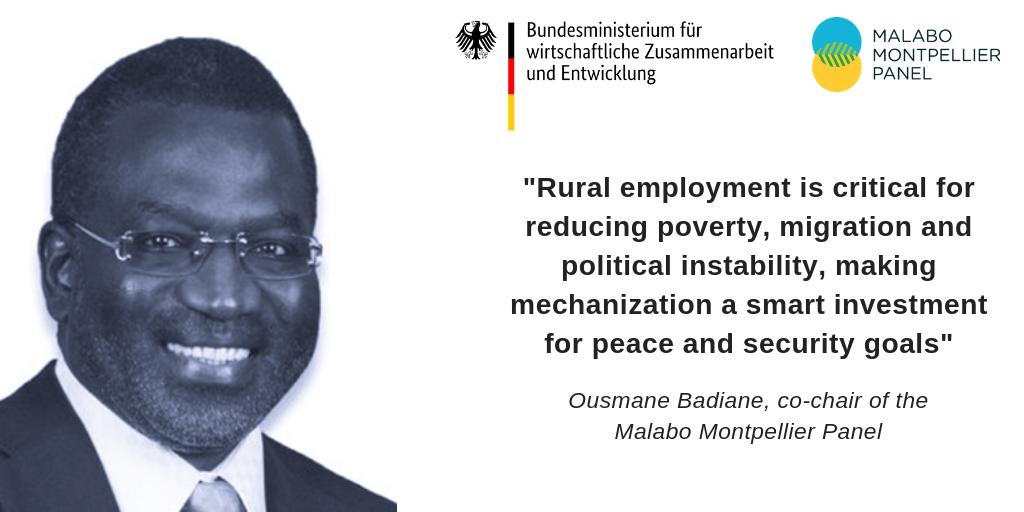
- Ousmane Badiane, IFPRI, Director for Africa
- Frank Nordmann, Grimme Agricultural Machinery
- Jehiel Oliver, Hello Tractor
- Jochen Moninger Deutsche Welthungerhilfe
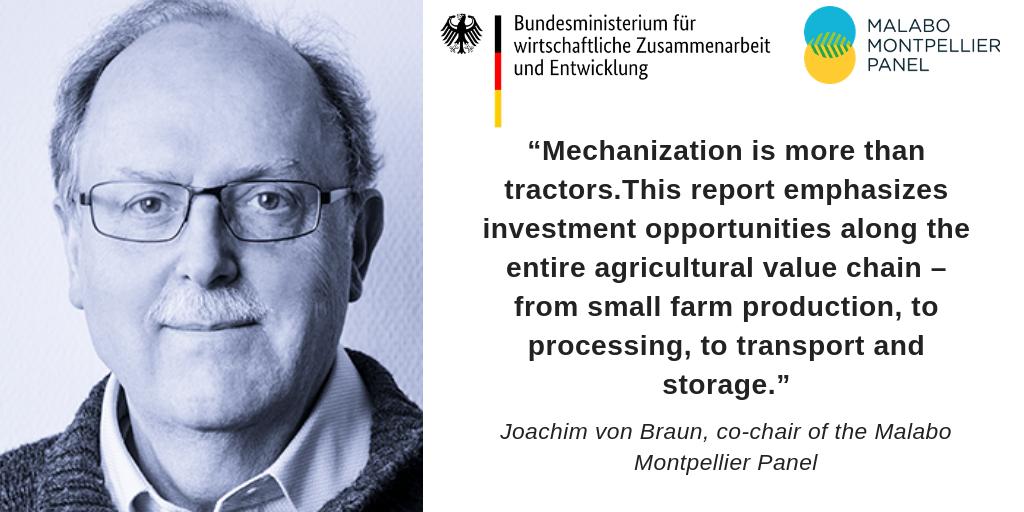
- Joachim von Braun, University of Bonn.
The German translation of this report is: MECHANISIERT Transformation der landwirtschaftlichen Wertschöpfungsketten Afrikas
- The report takes a broad perspective on mechanization, including technologies along the entire value chain and how they relate to agricultural development and job creation.
- The report shows what can be done to sustainably mechanize agriculture to increase production and enhance value addition across value chain segments. The set of policies and practices that are identified, if brought to scale, could have significant impact on agricultural transformation in Africa.
- The report provides a roadmap for African governments to take concerted action to deliver on the growth and transformation targets set out by the Malabo Declaration and the Sustainable Development Goals.
Analysis of the policies and investments made by seven African countries determined to be at the forefront of mechanization are a key feature of the report. Ethiopia, Morocco, Mali, Rwanda, Tanzania, Malawi and Zambia have all shown strong growth in both mechanization and agricultural output. Their experience shows that African countries can start to close the large gaps between themselves and other developing regions. Successful mechanization will be key to tackling major challenges on the continent, from spiraling food import costs to rampant rural unemployment.
The seven recommendations set out by the report are:
- Develop national agricultural mechanization investment plans that form part of countries’ National Agriculture Investment Plans
- Focus on mechanization pathways and strategies that generate new employment opportunities
- Prioritize mechanization along the entire food value chain, not just at production level
- Invest in supporting infrastructure, such as irrigation systems and electricity grids
- Incentivize the private sector to invest in mechanization through tax waivers and smart subsidies
- Use public-private partnerships to develop local machinery industries to ensure the technology is affordable and appropriate
- Provide localized services that match farmer demand with appropriate technologies
18 March 2019. Abidjan. The Malabo Montpellier Panel: High Level Policy Innovation through evidence and dialogue in agriculture
This event co-organised by the African Development Bank (AfDB) and the Malabo Montpellier Panel in Abidjan, Côte d’ivoire, will cover the thematic areas covered under the Panel’s first three reports and bring together members of the Panel to present the key findings and recommendations, and to exchange with the experts at the AfDB.
 They will also discuss the way forward regarding the appropriation of the outcome of the reports by policy makers and planners in order to inform policy reforms and investments to be supported by the Bank and other Development Partners. Particularly, the discussion will focus on the communication approach followed by the Panel so far and identifies possible improvement if necessary. Finally, during the event some insights on priority topics for future reports by the Panel will be discussed.
Since January 2017, the Malabo Montpellier Panel has published three reports.
- Nourished: How Africa Can Build a Future Free from Hunger and Malnutrition (September 2017);
- Mechanized: Transforming Africa’s agriculture value chains (July 2018);
- and Water-Wise: Smart Irrigation Strategies for Africa (December 2018).
The thematic areas covered under these reports tie in closely with the AfDB’s Hi 5 Agenda.

Source: PAEPARD FEED