
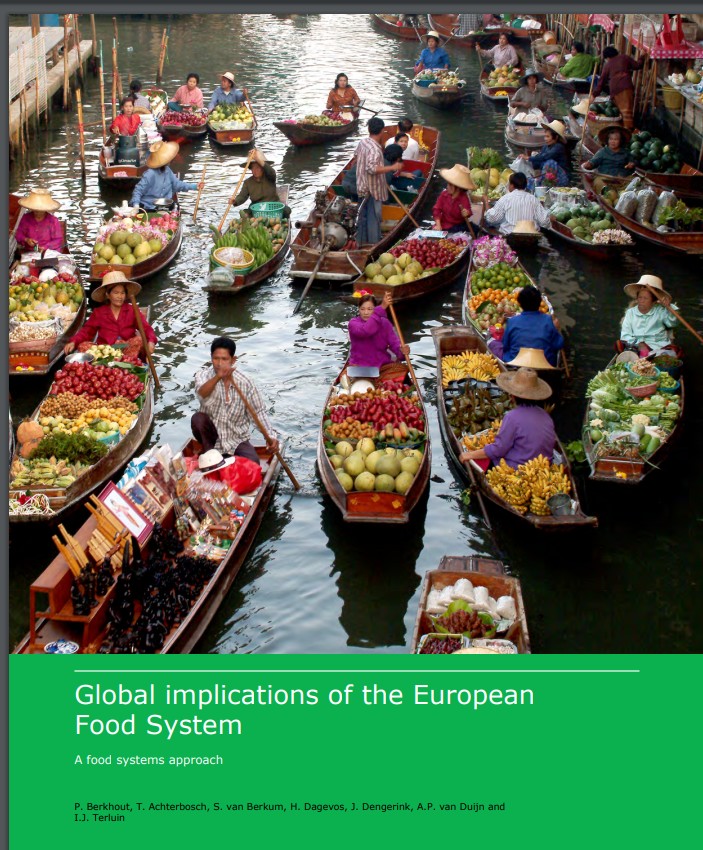
Berkhout, P., T. Achterbosch, S. van Berkum, H. Dagevos, J. Dengerink, A.P. van Duijn, I. Terluin, 2018. Global implications of the European Food System; A food systems approach. Wageningen, Wageningen Economic Research, Report 2018-051. 56 pp.; 4 fig.; 2 tab.; 73 ref.
The EU is a major player in the world market for agricultural products, both dependent on commodity imports from many countries, and exporting high-value agricultural products. There is a need to better understand the impact – on people, planet and profit – of the EU trade on food systems outside the EU, with a focus on Low- and Middle-Income Countries (LMIC).
- This report will help the EU to steer its actions and policies in other directions where this is deemed necessary to achieve the Sustainable Development Goals (SDGs).
- This report focuses on the global dimension of the European food system, by zooming in on the trade relations between the EU and the rest of the world and the effects of this trade on local food systems.
- The report was commissioned by the SCAR Strategic Working group ARCH. We thank the members of the SCAR Working group for their valuable comments and suggestions on a draft version of this report.
- an analysis of the trade relations between the EU and the rest of the world from several angles (total, by geographical blocs, by income blocs and by trade agreements), with a focus on Low- and Middle-Income Countries (LMIC);
- case studies of the effects of EU trade in three products – cocoa, soy and fish – on local food systems, based on social, environmental and economic indicators;
- an explorative analysis of possible changes in the EU food system and its impact on the food systems in third countries.
The top 5 of imported products by the EU28 from third countries includes fish (mainly fresh salmon and frozen shrimps & prawns), fruits and nuts (bananas and almonds), coffee and tea, residues from the food industry (oil cakes from soy bean meal), and oilseeds (soy bean and rapeseed). (page 15)
The top 5 of exported products by the EU28 to third countries includes beverages (wine and spirits in particular), dairy produce and eggs (cheese), meat (pig meat), cereals (wheat), and cereal preparations (flour); Shares of this top 5 were rather stable in the period 2000-2016 apart from cereal preparations, which increased from 5% in 2000 till 8% in 2016. (page 16)
- The production of cocoa has a serious impact on the environment. The deforestation of tropical forests and the impact of increasing use of agro-chemicals on soils and human health feature among the most researched outcomes. Smallholders in West-Africa increased their cultivated area by 3.3% annually during 1988-2007, causing 2.3m hectares of forest loss. The dominant model of full-sun cocoa farming significantly deteriorates soil quality. Another environmental risk that has the potential to negatively affect the livelihoods of cocoa farmers is climate change. A report by the International Centre for Tropical Agriculture) shows that the cocoagrowing regions in Ghana and Ivory Coast will see a temperature increase of up to 2.0 °C by 2050, resulting in a major reduction in climate suitability for coco. (page 19)
- One of the major environmental impacts of soy production is land-use change and associated
deforestation. Yearly, 3.7m hectares of forests disappear in major soy producing countries Argentina, Brazil and Paraguay. Since 2000, the soy cultivation growth area has grown by more than 10% a year in these countries. Monoculture soy production and deforestation both contribute to problems of soil degradation. Moreover, pesticide use in soy production is known to produce adverse health effects in soy producing areas. Soy production is associated with different societal impacts. In the search for new agricultural land for soy cultivation, land conflicts often arise. Soy producers are known to encroach on nature reserves and reserves for indigenous people. Mechanisation of soy production has reduced the employment opportunities in soy production, but has increased the income opportunities for farmers producing soy. Other concerns are raised about the extent to which land converted for soy production can no longer support food crops that are needed to meet the local food demand. (page 21-22)
- While the 28 EU countries capture fisheries in waters beyond the national jurisdiction of EU
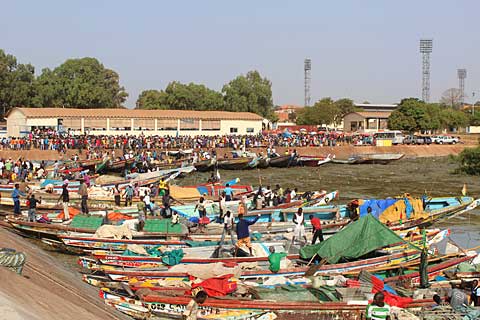
Member States put an excessive pressure on marine resources, there is an increasing reliance of West Africa’s coastal population on fisheries for their food and income despite decreasing total income and increasing fishing costs, which in turn aggravated poverty. Small-scale fishing in West-Africa is an activity of last resort. Despite the fact that small-scale fishing is not a source of sustainable livelihood, the number of people depending on fisheries is still increasing. Some sceptics link the loss of fisheries livelihoods to conflicts and dislocations on the African continent with migration and its accompanying environmental, economic, social and health & safety issues as a result (page 26)


The brunt of open data in LMIC is geared to support research on agriculture, livelihoods and environmental impact; it covers much less of the perspectives on food processing and transformation, on distribution &and provision, and on increasingly complex behavioural drivers of food choice, habitual diets and nutrition outcomes. The brunt of data on the downstream food systems activities sits with the private sector, in LMIC as well as in the EU. (page 36)

Source: PAEPARD FEED