
 24 May 2019. Durum wheat is an important food crop in the world and an endemic species of sub-Saharan Africa (SSA).
A new publication (May 2019, 20 pages) convincingly demonstrates the potential of releasing durum wheat varieties adapted to all growing conditions of SSA, from the oases of the Sahara to the highlands of Ethiopia – is substantial.
In the highlands of Ethiopia and the oases of the Sahara this crop

has been cultivated for thousands of years. Today, smallholder farmers still grow it on marginal lands to assure production for their own consumption. However, durum wheat is no longer just a staple crop for food security but has become a major cash crop.
In fact, the pasta, burghul and couscous industry currently purchase durum grain at prices 10 to 20% higher than that of bread wheat. Africa as a whole imports over €4 billion per year of durum grain to provide the raw material for its food industry. Hence, African farmers could obtain a substantial share of this large market by turning their production to this crop.
- The durum breeding program of Ethiopia reveals a steep acceleration in variety release and adoption over the last decade.
- The variety release for Mauritania and Senegal shows how modern breeding methods could be used to deliver grain yields above 3 t ha−1 in seasons of just 92 days of length and in daytime temperatures always above 32 ◦C.
Filippo Bassi,
at Terbol Station, Lebanon“We have actually two projects on pre-breeding with the Crop Trust. The first one started 4 years ago under the leadership of the University of Nottingham, Prof Ian King. The team has been able to generate several hundreds of new crosses between Crop wild relatives (CWR) and new ICARDA and CIMMYT durum elite material. This year we are conducting a multi-locations test and we worked with our partners from North Africa and India to select the best one to start yield testing next year.”
“The durum program of ICARDA is already strongly based on Crop wild relatives (CWR)-derived germplasm, with more than 60% of all our elites obtained that way. We are beating the commercial cultivars by 10-20% yield in developing countries, and even went as far as surpassing the best commercial varieties in Europe and Australia.”
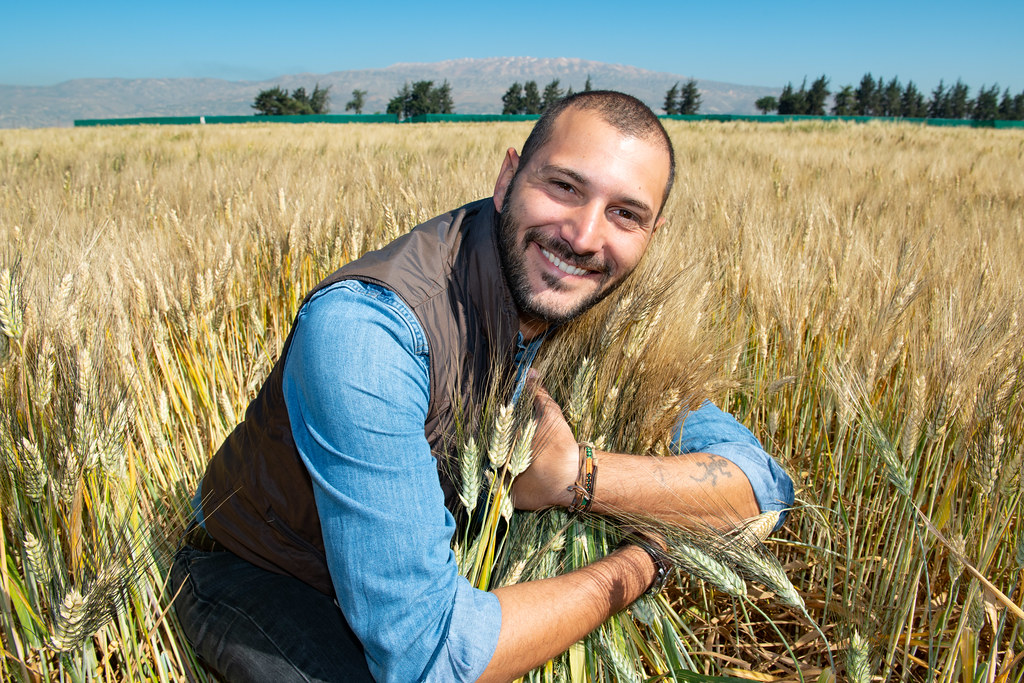
“A participatory approach, that uses the farmers themselves to guide the breeding decisions helps hugely in achieving success. A simple example was for an advanced line that I really liked: the yield was very high, the grains very big, and it had very good disease resistance. Still, when I showed it to farmers they did not like it. The main reason was that it was too short, and they could not get enough straw to feed their livestock. This is but an example on how incorporating farmers’ opinions save me from investing a lot of efforts in releasing and promoting a variety that would have never made it to cultivation”. Filippo Bassi (see picture), Senior Scientist – Durum Breeder, Breeding programs (Wheat Barley Legumes) ICARDA
 New breeding technologies offer great promise for expanding the area of durum wheat production in SSA. However this remains primarily dependent on the market ability to purchase these grains at a higher price to stimulate farmer adoption.
 |
| Durum Wheat Processing Machine |
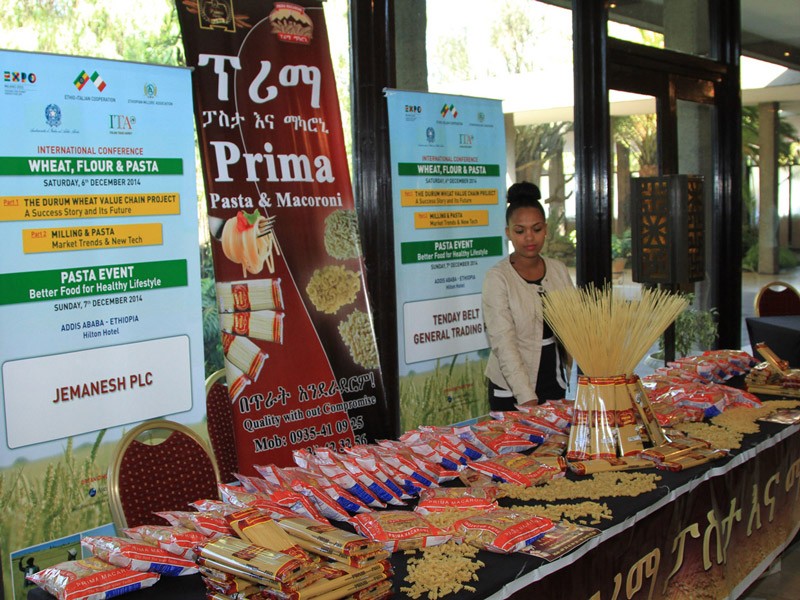
A significant effort has been made to expand the production of improved durum wheat cultivars to supply raw materials to the food industries. The pasta producers used to rely on massive importation of durum wheat grains, which was not a sustainable long-term business strategy due to high and volatile costs. Further, the purchase of foreign grains competed with other national priorities for the use of governmental hard currency stocks.
 Recent investments in the pasta industry are proving extremely promising in Ethiopia thanks to new food habits of the growing urban populations, which are looking for fast and tasty foods, while still cheap and nutritious. The Ethiopian Millers Association has eagerly explored the possibility to procure the needed raw material directly from local farmers to reduce production costs and increase competitiveness against foreign pasta imports. Unfortunately, the local production did not guarantee sufficient rheological grain quality to satisfy the industrial needs. In fact, grain of tetraploid landraces does not meet industrial standards in terms of colour or protein quality.
 Hence, specific incentives needed to be provided to farmers to obtain industrial-grade harvests. The scope of the Ethiopian-Italian cooperation project for the Agricultural Value Chain in Oromia (AVCPO) was to re-direct some of the already existing bread wheat production system of the Bale zone toward the more lucrative farming of durum wheat for the industry.
The process acted on the key elements required by the pasta industry to stabilize and self-sustain the value chain:
- competitive price,
- high rheological quality for conversion into pasta,
- easy and timely delivery,
- consistent stock of grains and predictable increases over years
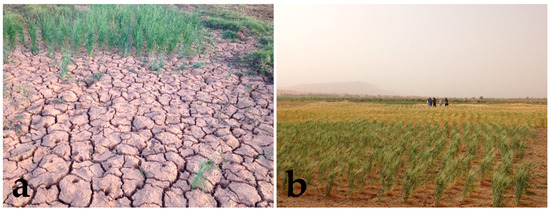 |
| Wheat cultivation in oasis in Mauritania. (a) Holes in the mud for the planting of durum wheat as the water retreats; (b) Gradient on plant maturity caused by the difference in planting time following the retreat of the water |
- Egyptian breeders could help in delivering varieties targeted to the hot and irrigated areas of mega-environment type ME1, such as West Africa and Sudan.
- The other North African countries could target ME4A, with low rainfall and cold winters, as well as help in the further development of the Saharan oases.
References:
- A. T. Sall, Tiberio Chiari, W. Legesse, K. Seid-Ahmed, R. Ortiz , M. van Ginkel and F.M. Bassi “Durum Wheat (Triticum durum Desf.): Origin, Cultivation and Potential Expansion in Sub-Saharan Africa” has been published in Agronomy as part of the Special Issue Durum Wheat Breeding and Genetics. (May 2019, 20 pages) Special Issue “Durum Wheat Breeding and Genetics”. A special issue of Agronomy (ISSN 2073-4395). This special issue belongs to the section “Crop Breeding and Genetics“.
- Breeding better durum in Morocco. Queensland country live. 05/05/2019
- Breeding better durum in Morocco. Farm Online. 06/05/2019
- HEAT-TOLERANT DURUM WHEAT FOR SENEGAL BASIN 13/03/2018
- Genomic Prediction to Deliver Heat Tolerant Wheat to the Senegal River Basin (Phase II)
1 jan. 2018 – 31 dec. 2021
Learn about how the 2017 Olam Food Prize winner is re-imagining agriculture through the development of a super heat tolerant wheat in the Senegal Basin. As part of its 25th Anniversary celebrations in 2014, Olam launched the Olam Prize for Innovation in Food Security in partnership with the international scientific organisation, Agropolis Fondation.
Agricultural Value Chains Project in Oromia (AVCPO)

Source: PAEPARD FEED